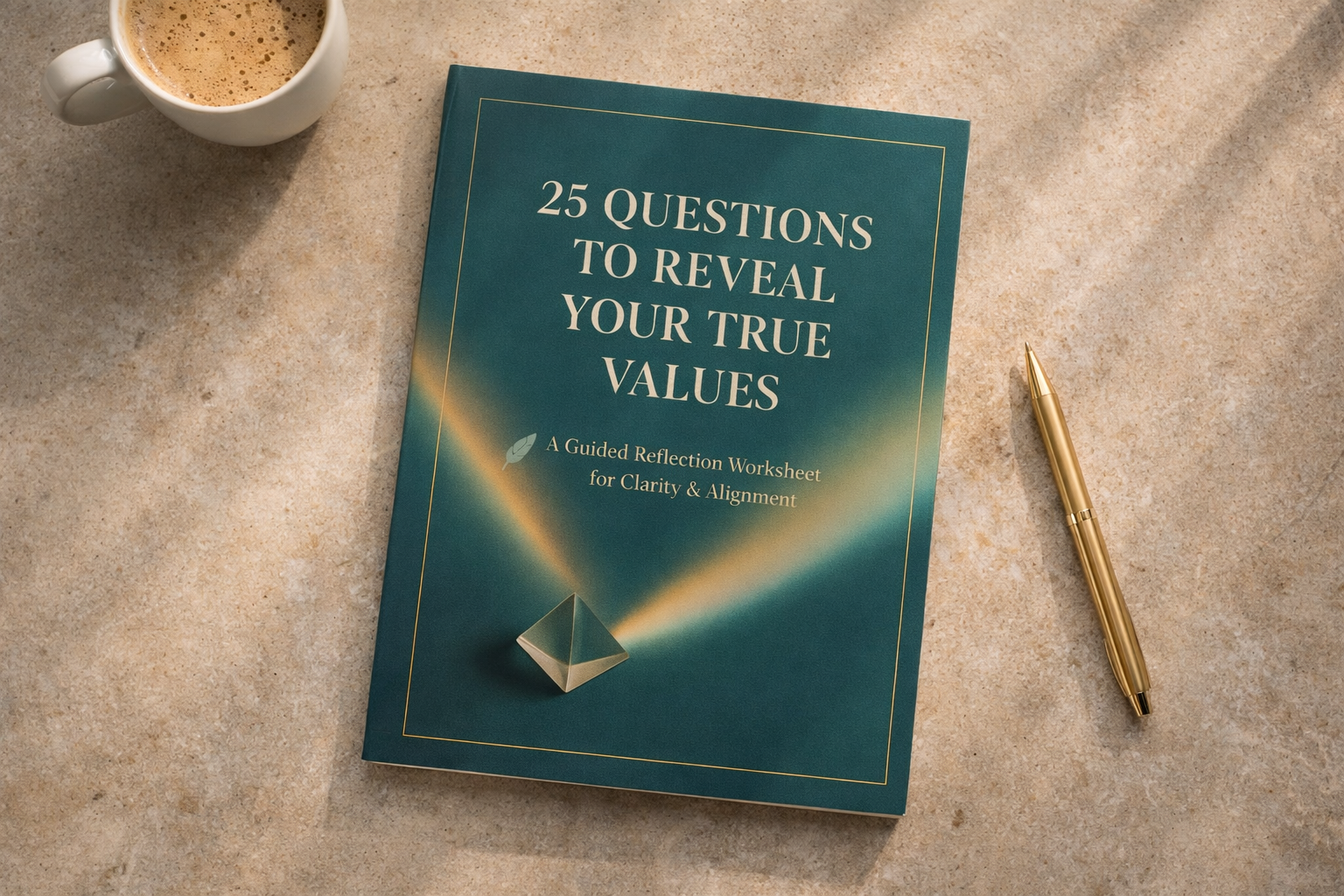
A Guided Reflection Worksheet for Clarity, Alignment & Life Design
Most people think they know their values. This belief is tested when they face a hard decision. It is challenged by a draining relationship or a life that doesn’t quite feel right anymore.
That’s because personal values aren’t something you decide once and move on from.
They’re something you notice, recognize, and listen to — over time.
Your values show up quietly:
- In what energizes you
- In what drains you
- In what feels deeply right or unmistakably wrong
This guided reflection worksheet is designed to help you discover your true values by hearing them more clearly.

Why Your Values Matter More Than You Think
Your values influence:
- The decisions you make (and avoid)
- The boundaries you set (or struggle to set)
- The goals you pursue
- The relationships you stay in
- How aligned — or disconnected — your life feels
When your choices align with your values, life feels steadier and more intentional.
When they don’t, even a life that looks “successful” on the outside can feel exhausting.
Here’s the key most people miss:
Values aren’t discovered by thinking harder.
They’re revealed through reflection and lived experience.

How This Values Reflection Works

This process isn’t about finding the “right” answers or defining yourself in a single sitting.
It’s about noticing patterns.
The 25 value-based questions are divided into three gentle phases:
1. Identity & Self-Discovery
Questions that help you reconnect with who you are when you’re most yourself without pressure, labels, or performance.
2. Emotions, Boundaries & Inner Truths
Questions that surface how alignment (or misalignment) shows up in your emotions, body, and relationships.
3. Vision, Alignment & How You Move Through the World
Questions that look forward not to force answers, but to notice what your life is naturally asking you to grow into next.
There is no right pace.
You don’t need to answer everything at once.
This reflection is meant to be returned to — not rushed through.
What These Questions Help You Uncover

As you move through the worksheet, you may begin to notice:
- Certain themes repeating
- Specific emotions standing out
- Moments that felt expansive or constricting
- Situations that felt deeply aligned or deeply off
These patterns are not random.
They are signals.

What This Worksheet Is and What It Isn’t
To be clear and transparent. This worksheet helps you:
- Uncover the raw material of your personal values
- Recognize emotional, relational, and behavioral patterns
- Build clarity around what truly matters to you
It does not:
- Ask you to label or rank your values
- Organize them into a final values framework
- Turn them into a full decision-making system
That work comes next.
This step is the foundation.
How to Use This Values Worksheet Well
Before you begin, a few grounding reminders:
- Answer honestly, even if your responses feel unfinished
- Notice what feels light, heavy, or charged
- Don’t edit yourself
- Let your answers surprise you
You don’t need to justify or explain what you write.
Awareness is enough for now.
Download the Free Values Reflection Worksheet
You can download the free “25 Questions to Reveal Your True Values” worksheet here:

👉 [Download the Guided Values Reflection Worksheet]
Take your time with it.
Return to it as your life shifts.
Let clarity unfold naturally.
What Comes After You Discover Your Values
After completing this reflection, many people begin asking:
- “How do I name what I’m seeing?”
- “How do I organize these insights into something practical?”
- “How do I make decisions that actually reflect my values?”
Those questions matter and they’re answered through deeper frameworks and guided tools.
For now, trust this step. Your values are already present.
This reflection is simply how you begin to recognize them
Next: Understanding How Your Values Actually Work
Discovering your values is the first step.
The next is understanding how they shift, express, and adapt across seasons of your life.
In the next post, we explore the difference between core values and contextual values. Confusion around this distinction often makes people feel like they’re “losing” their values. In reality, they’re actually evolving.
→ Read next: Core vs. Context Values — What’s the Difference?
Leave a Reply